
Shokupan, also known as Japanese milk bread, is a staple in Japanese bakeries and households. This soft, fluffy, and slightly sweet bread is a testament to Japan’s dedication to perfecting even the simplest foods. Unlike traditional Western breads, Shokupan is made using a special technique called tangzhong, which involves pre-cooking a portion of the flour with liquid to create a thick paste. This method helps retain moisture, giving Shokupan its signature pillowy texture and extended shelf life. Whether served plain, toasted, or used for sandwiches, Shokupan remains a cherished part of Japanese cuisine.
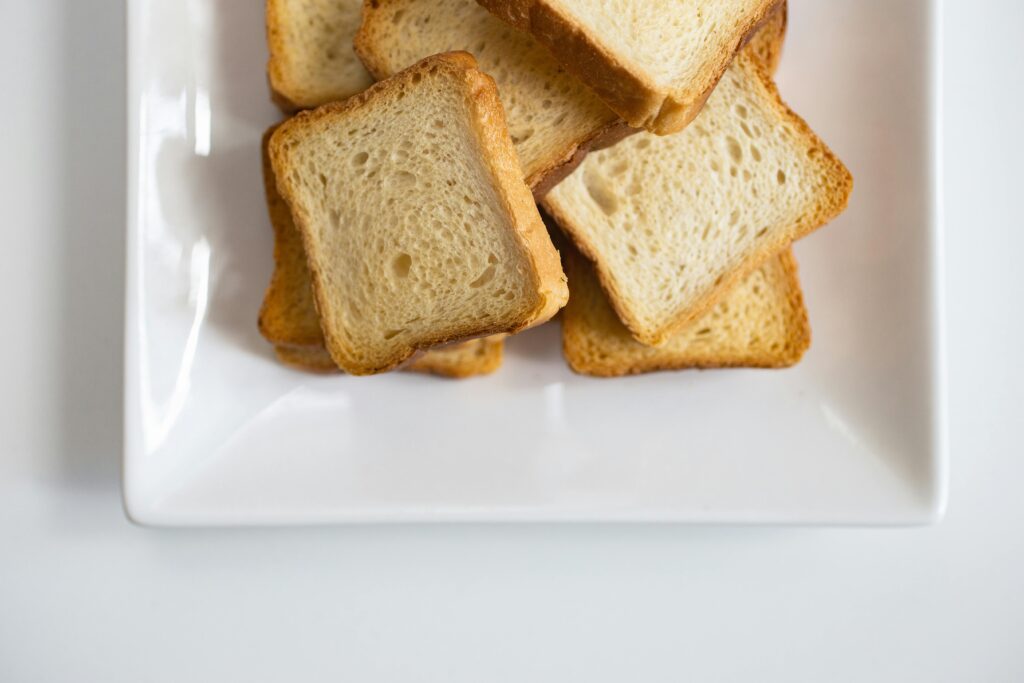
Beyond its delicious texture, Shokupan holds cultural significance in Japan. Introduced in the early 20th century, it was influenced by Western-style breadmaking but adapted to Japanese tastes and techniques. The post-war era saw its popularity rise, as it became an accessible, affordable, and versatile food option. Today, it is commonly enjoyed for breakfast with a light spread of butter and jam, used for katsu sandos (pork cutlet sandwiches), or even transformed into a sweet treat with condensed milk and honey. Its role in daily life makes it more than just bread—it is a comfort food deeply woven into Japanese culinary traditions.
A key factor that sets Shokupan apart from other breads is its meticulous preparation process. The use of tangzhong ensures that the bread remains soft for days, while the slow proofing and careful shaping create an airy yet structured crumb. Unlike many store-bought loaves, which can be dense or dry, Shokupan has a melt-in-your-mouth texture that is almost cake-like. This is why many Japanese households still prefer homemade or bakery-fresh Shokupan over mass-produced versions.
Shokupan also embodies Japan’s “shokunin spirit”, the philosophy of craftsmanship and dedication to perfecting a skill. Japanese bakers spend years mastering the art of kneading, folding, and proofing to achieve the perfect loaf. Some bakeries even treat Shokupan as a luxury item, offering premium versions made with high-quality butter, milk, and flour. This attention to detail reflects Japan’s broader culinary ethos—where even the simplest foods are refined to the highest level of excellence.
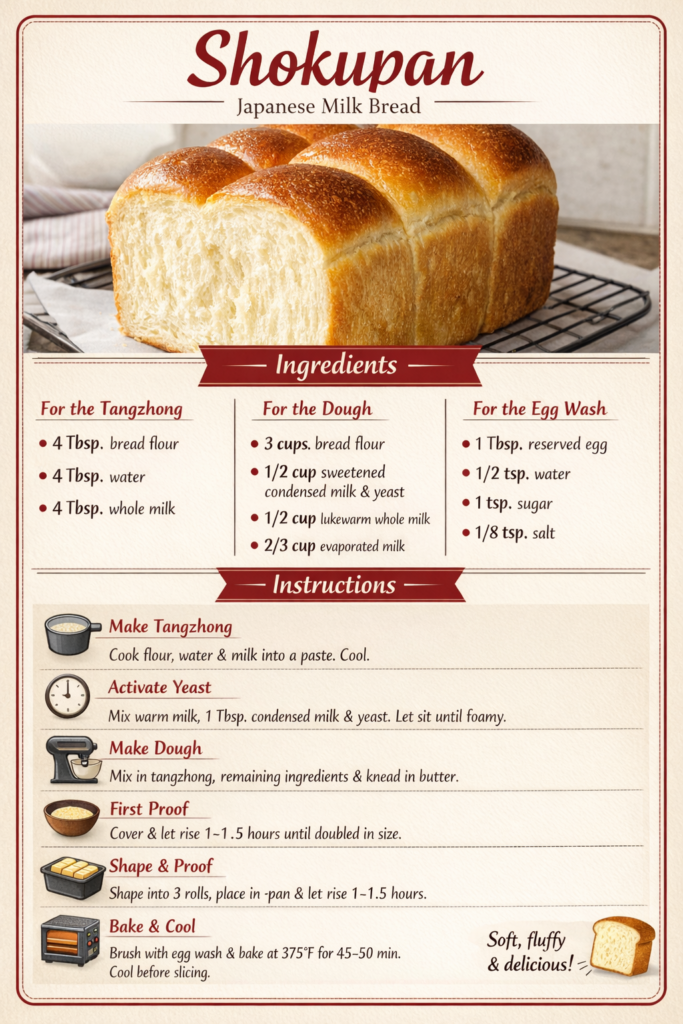
Whether you are a seasoned baker or a beginner looking to try your hand at making Japanese milk bread, Shokupan is a rewarding recipe to master. Below is a carefully formatted version of the recipe to help you create this beloved bread at home.
Shokupan (Japanese Milk Bread) Recipe
Ingredients
For the Tangzhong
For the Dough
- 4 Tbsp. butter, cubed, softened (56 g), plus more for pan
- 3 cups bread flour (384 g)
- 1 (0.25-oz.) packet active dry yeast (7 g)
- 1 large egg, beaten (reserve 1 Tbsp. for egg wash)
- 1 1/4 tsp. kosher salt
- 1/2 cup sweetened condensed milk, divided (156 g)
- 1/2 cup whole milk, lukewarm (120 g)
- 2/3 cup evaporated milk (160 g)
For the Egg Wash
- 1/2 tsp. water
- 1 tsp. granulated sugar
- 1/8 tsp. kosher salt
- Reserved 1 Tbsp. egg
Directions
Step 1: Make the Tangzhong
- In a small saucepan over medium-low heat, whisk together bread flour, water, and whole milk until smooth.
- Whisk constantly while cooking until the mixture thickens into a soft, springy paste (about 1–2 minutes).
- Remove from heat and let cool to room temperature.
Step 2: Activate the Yeast
- In the bowl of a stand mixer, stir together lukewarm whole milk, 1 Tbsp. sweetened condensed milk, and yeast.
- Let sit for about 15 minutes, until foamy.
Step 3: Prepare the Dough
- Remove 1 Tbsp. of the beaten egg and reserve for the egg wash.
- Add to the mixer bowl: the remaining beaten egg, cooled tangzhong, remaining condensed milk, bread flour, evaporated milk, and kosher salt.
- Mix on low speed until a loose dough forms.
Step 4: Knead the Dough
- Increase the mixer speed to medium and knead for about 3 minutes, until the dough becomes smooth.
- Scrape down the bowl, then increase speed to medium-high and knead for another 3 minutes.
- Gradually add cubed, softened butter, beating until the dough pulls away from the bowl (12–15 minutes).
Step 5: First Proof
- Cover the bowl and let the dough rest until almost doubled in size (1 hour 15 minutes to 1 hour 45 minutes).
Step 6: Shape the Dough
- Punch down the dough and turn it out onto a lightly floured surface.
- Divide into three equal pieces.
- Flatten each piece into a ½”-thick rectangle and fold in thirds like a letter.
- Turn the dough 90°, flatten again, and repeat the fold.
- Roll each piece into a tight coil.
Step 7: Second Proof
- Butter a 9″ x 5″ loaf pan.
- Place the dough pieces seam-side down in the pan.
- Let proof until slightly more than doubled in size (about 1 hour 15 minutes to 1 hour 45 minutes).
Step 8: Bake the Bread
- Preheat oven to 375°F (190°C) 20 minutes before baking.
- In a small bowl, whisk together the egg wash ingredients (reserved egg, water, granulated sugar, kosher salt).
- Brush the top of the proofed loaf evenly with the egg wash.
- Bake for 45–50 minutes, until deeply golden brown and the internal temperature reaches 195°F.
- (If the top browns too quickly, cover with foil after 25 minutes.)
Step 9: Cool & Serve
- Let the bread cool in the pan for 10 minutes, then transfer to a wire rack.
- Allow to cool for at least 1 hour before slicing.
Shokupan is more than just a bread recipe—it is a representation of Japanese culinary mastery and tradition. Whether enjoyed fresh out of the oven, toasted with butter, or as the base for a luxurious fruit sando, this soft and airy bread is bound to become a favorite in your kitchen. Happy baking!
Recipe Card